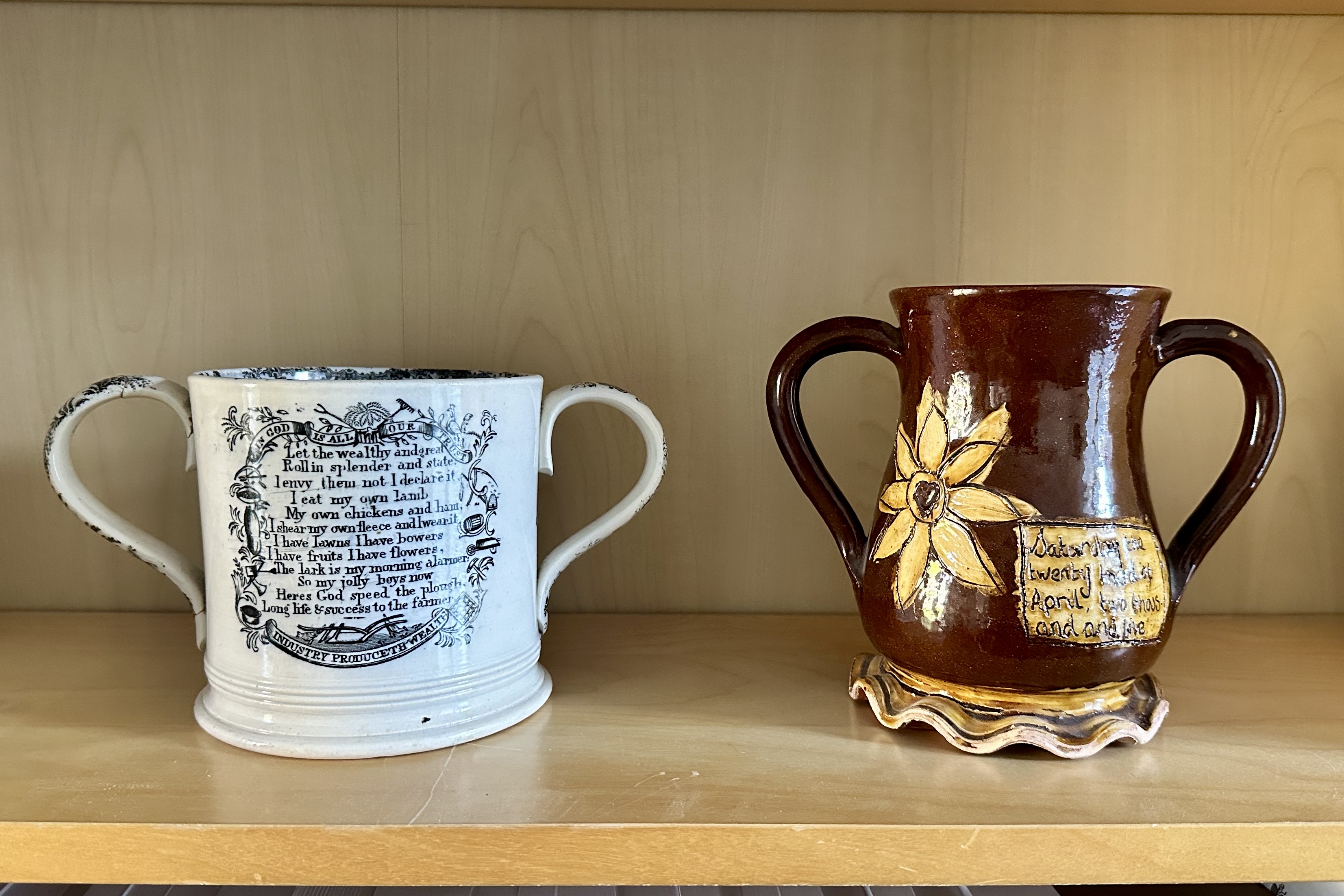
There are two loving cups on a shelf in my office.
They sit next to each other now, deliberately, having spent the previous several years in less considered arrangements. Putting them on display side by side was the work of an idle Sunday last month, when I was clearing out the last vestiges of childhood from what used to be known as the playroom until it was vacated by our youngest teenager, and rationalising the shelves in my office to accommodate the displaced books and games. A small act of domestic curation, of the sort that only feels significant in retrospect.
The older of the two is a Victorian piece, ceramic, with the characteristic two-handled shape that makes a loving cup a loving cup — a vessel not for solitary drinking but for passing between hands. Claude tells me it dates from somewhere around 1820 to 1860, the sort of confident-sounding range that you can now obtain in seconds for any inherited object you choose to photograph. It belonged to my great-grandmother, Ellen “Nellie” Parkin, and reached me via my Mum. I don’t know whose wedding it marked, or indeed whether it ever marked a wedding at all.
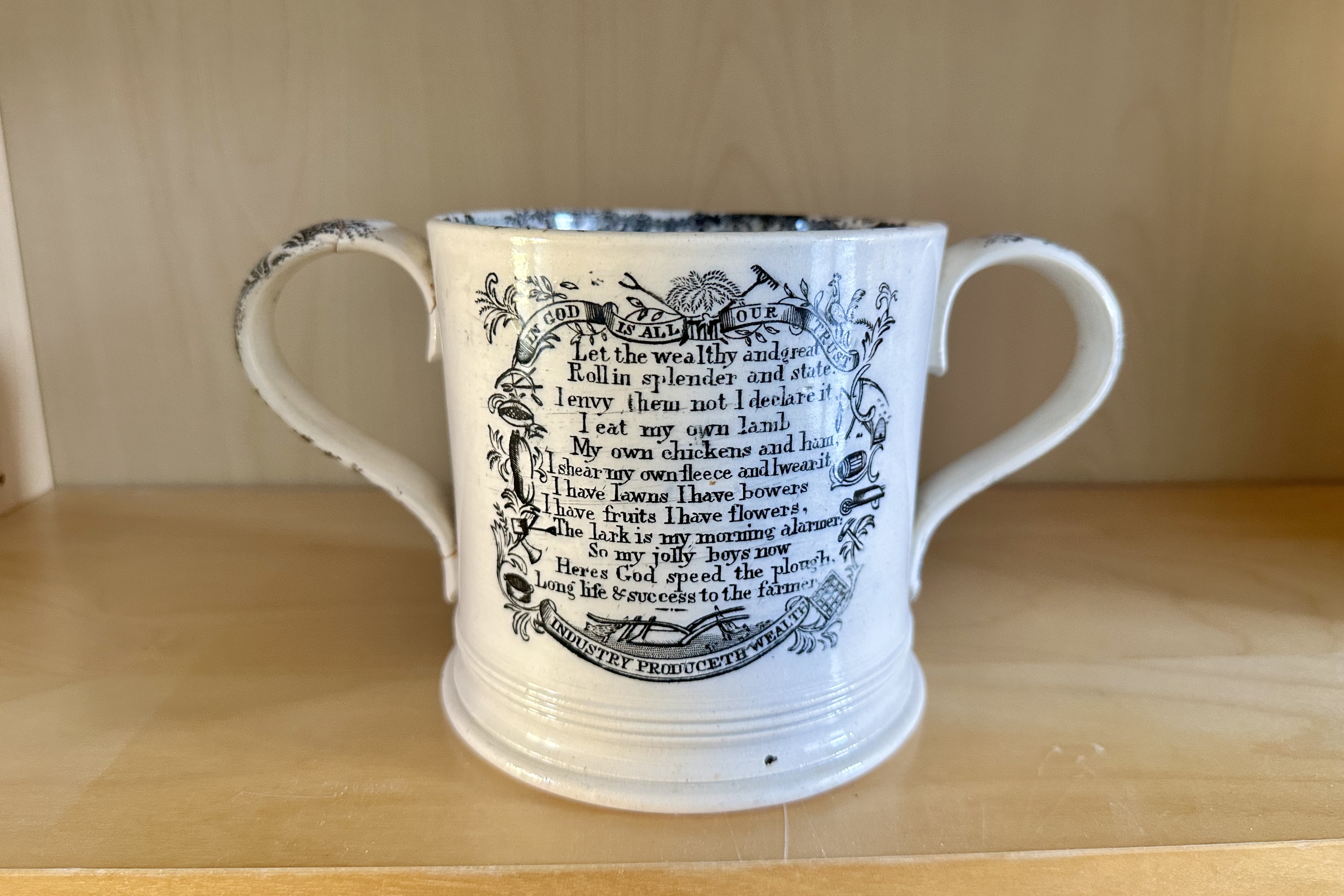
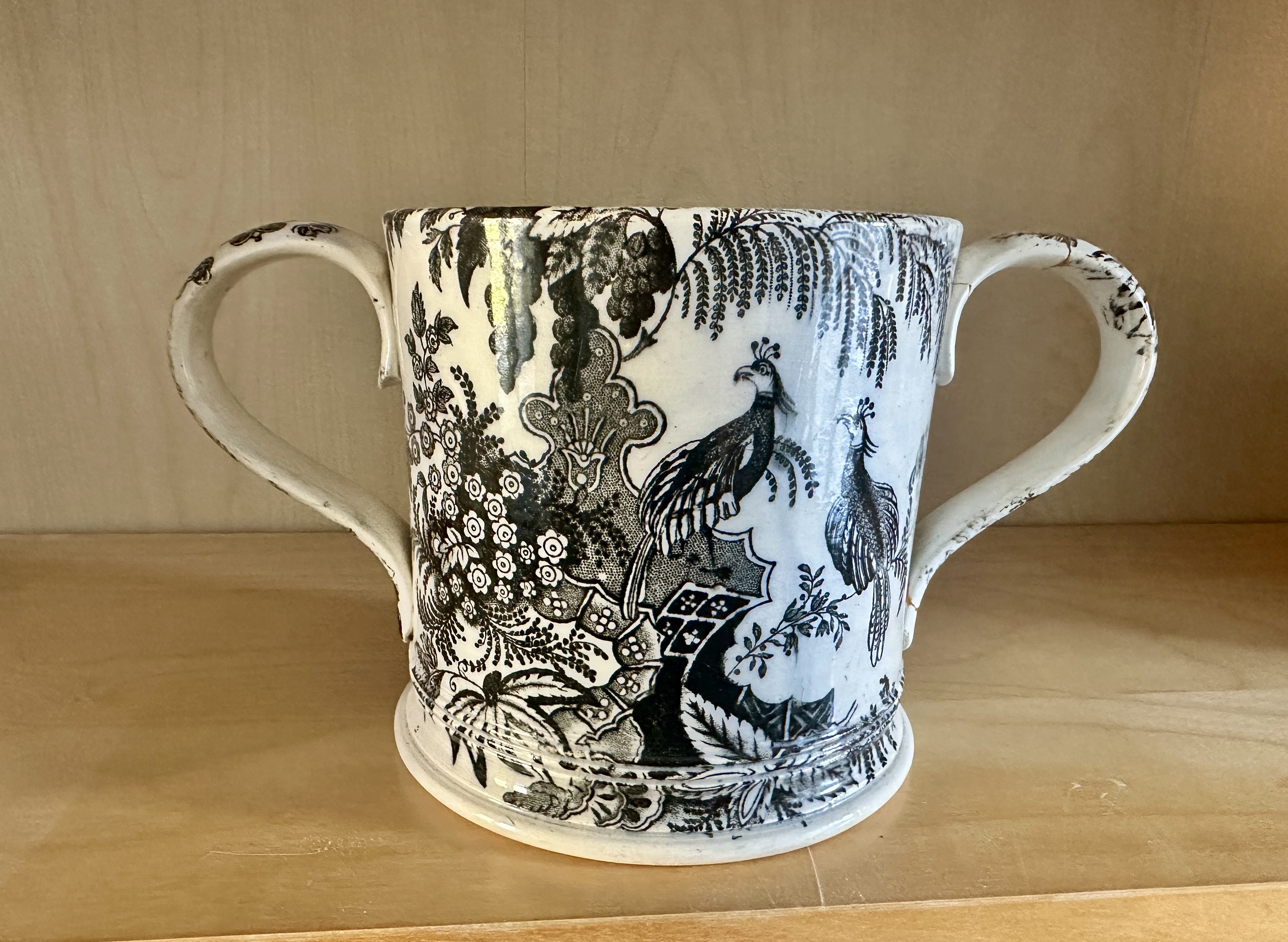
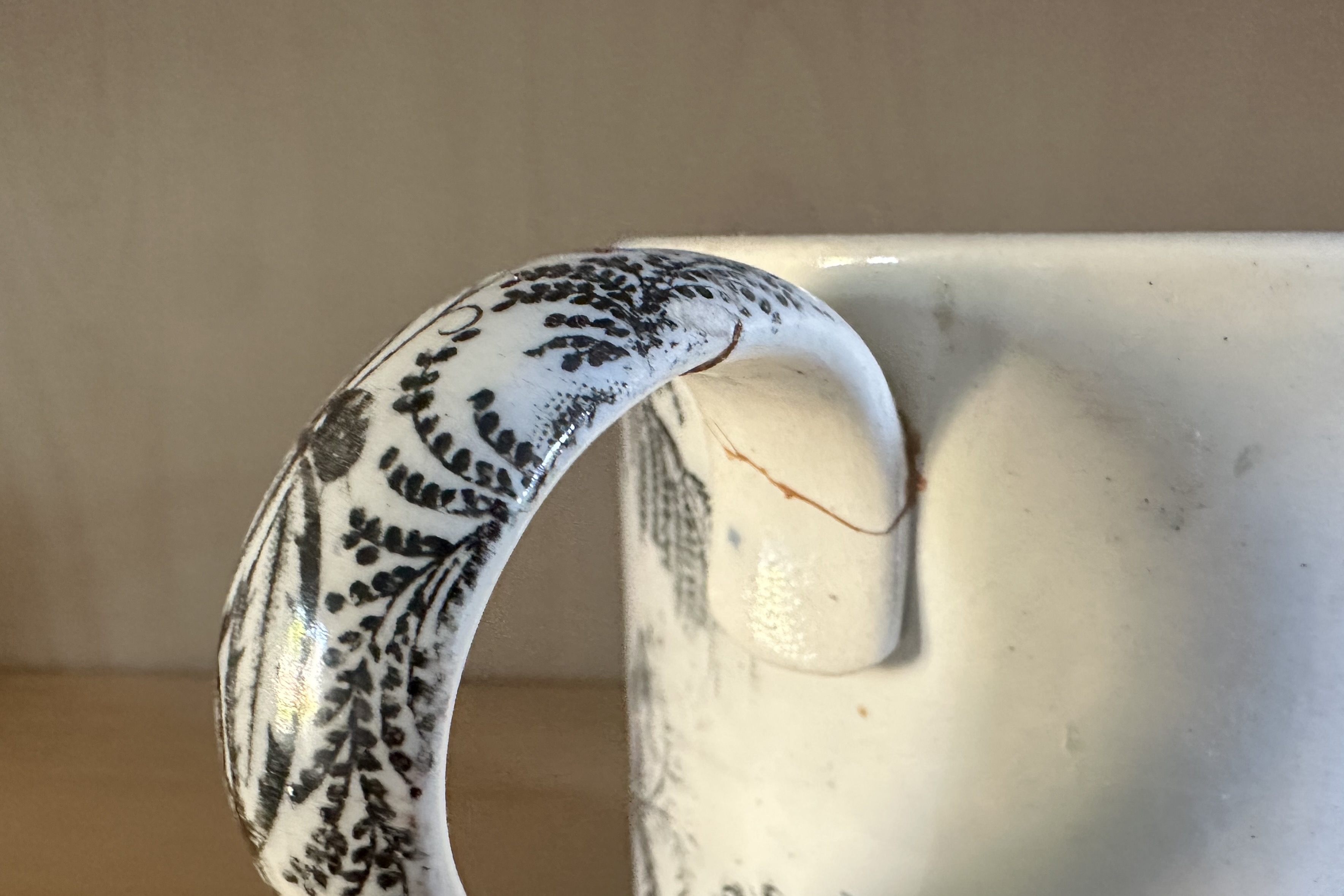
It came to me, I suspect, because of the Araldite. One of the handles was broken at some point in my boyhood by me, in circumstances I no longer remember, and has been glued back together. The repair is quite visible. I have two elder sisters who one might think would be more suitable inheritors of such ornamental family heirlooms, and I have often mused on why this one came into my possession. I suppose it’s because the cup and I were already intimately acquainted: you break it, you keep it.
The younger cup is contemporary — a handmade piece given to Jocelyn and me on our wedding day by Dawn Sharkey, who was at the time the girlfriend of my friend Jammy. Being the same age as my marriage makes it a relative newcomer to the world of objects, but old enough that the relationship which produced it has long since dissolved. Dawn moved on. Jammy is no longer with us. The cup, indifferent to the lives of humans, sits on my shelf and continues to be a cup.
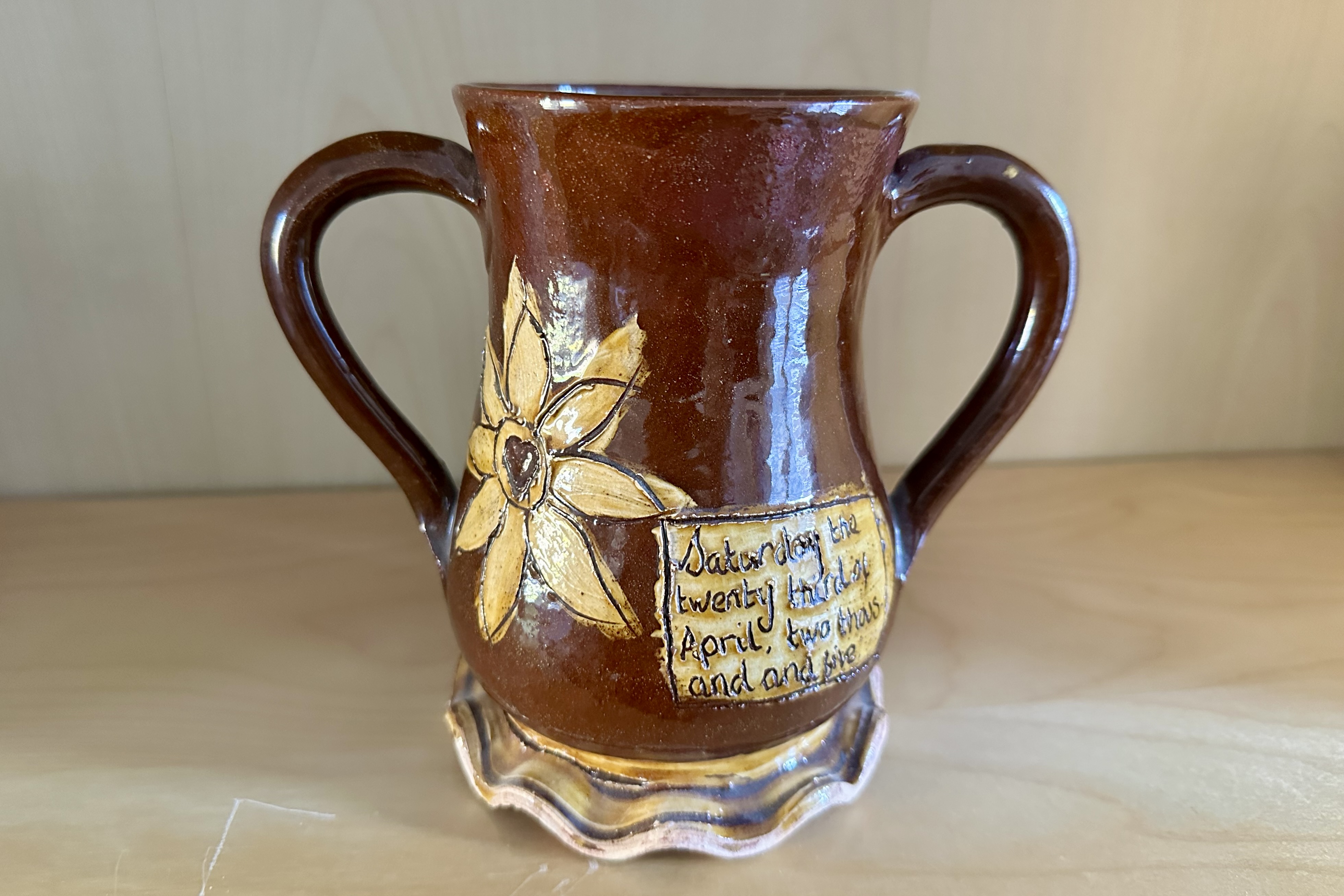
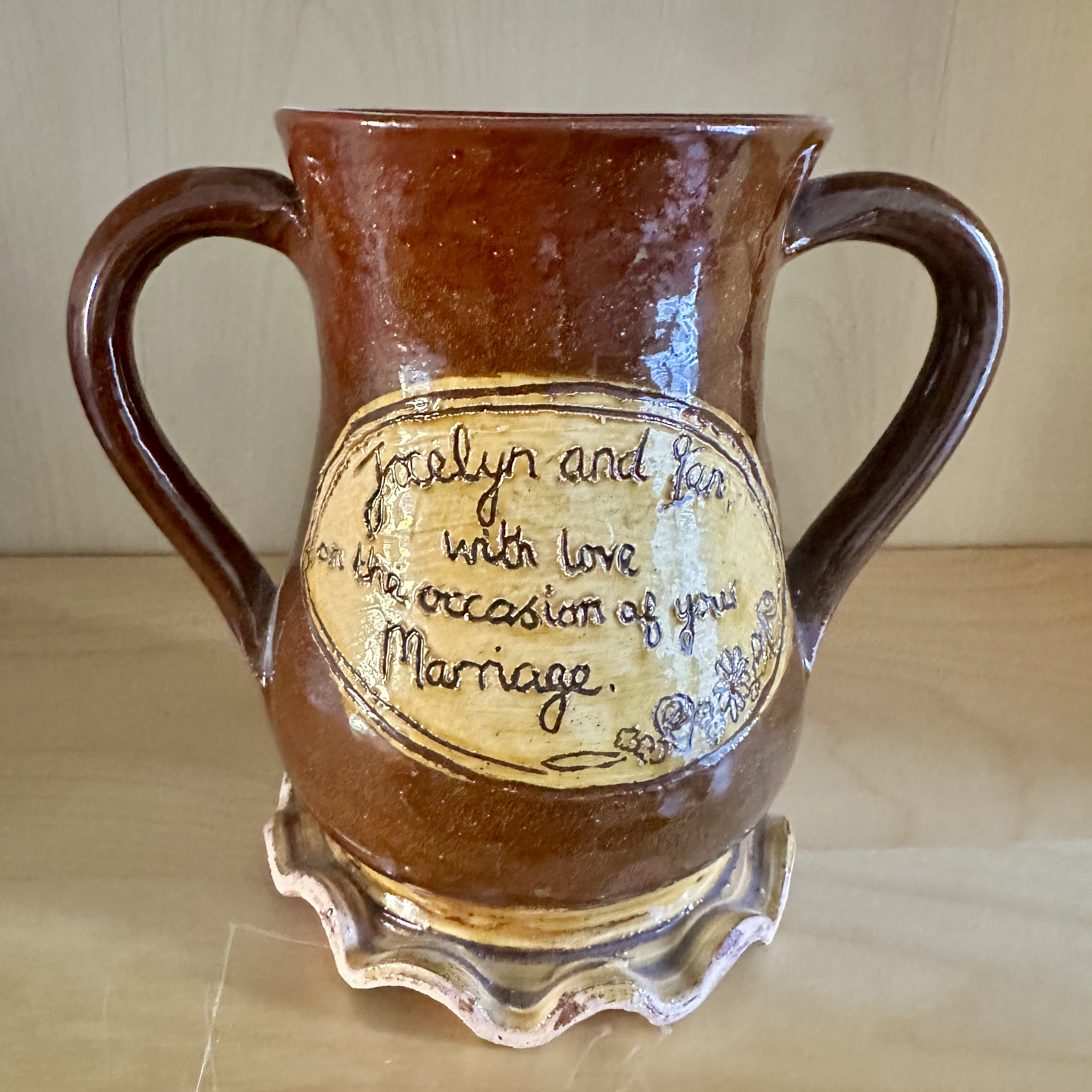
I’m not sure why I felt the urge, when I was ostensibly having a “clean out”, to put these two objects next to each other in pride of place in my office, but it felt right when I did it, and it has continued to feel right in the days since. I like that the two cups are united by form and by intent — both objects made to be given, both vessels for the kind of ceremony that humans have been performing for as long as we’ve had pottery. Separated by maybe 175 years, a couple of industrial revolutions, most of the reigns of Victoria and Elizabeth, plus a pair each of Edwards and Georges.
As I understand it, the Victorian cup, when it was made, would not have been a precious thing. Loving cups were common domestic ware in the nineteenth century, the sort of thing produced in volume by the Staffordshire potteries and given as a matter of course at weddings and christenings. I wonder how many of its contemporaries ended their days as fragments in landfill, or as the kind of battered curio that turns up at car boot sales for three quid. Mine has survived because someone in each generation decided it was worth keeping, and passed it along. That this someone included a small boy with butterfingers, living at a time of industrial adhesive, is just part of the cup’s story now — some additional character.
Dawn’s cup, by contrast, is at the start of its own gauntlet. It feels pretty sturdy, so I have faith that in two hundred years, if it survives the same trials of accident, indifference and house moves, someone will hold it without knowing who Dawn was, or Jammy, or me, or Jocelyn. Our names will have gone the way of Nellie Parkin’s wedding guests. Unlike Nellie’s, this cup bears the date of our wedding on its side, so the future holder won’t need to ask an AI when it was made. Maybe they’ll find this blog in some futuristic version of the Wayback Machine! The wheel of provenance will turn.
I sit looking at my two loving cups in breaks between my work, and I think a lot about the passage of time. About family, and marriage, relationships and friendships. One cup reached me through ancestry, lightly damaged and lovingly mended. Another came to me through friendship, at the time of my own marriage, which set in train the lives and stories of the next generation. I miss Jammy terribly. I would have enjoyed messaging him recently about finally starting to learn the guitar at the age of fifty, and about the stupid alphabetical music-listening quest I am currently undertaking, among other things. Somehow the cup from Dawn, sitting on the shelf next to Nellie’s, does a little of the job that the friendship can no longer do directly.
I don’t think this is what loving cups were originally intended for. But it seems to be one of the things they’re for now.