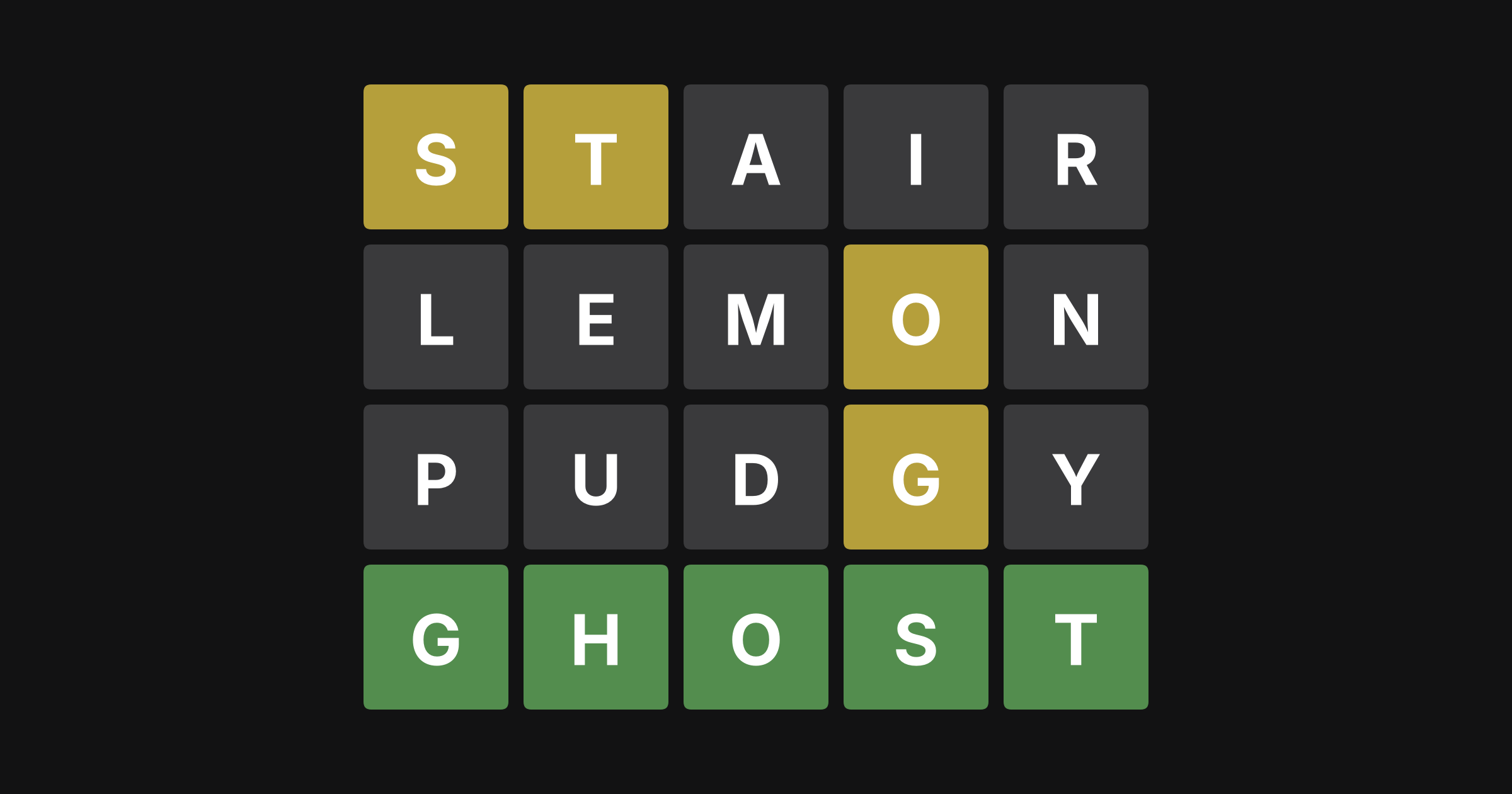
A note before we begin. This is a guest post. Every word of it, and every chart, was generated by Claude Opus 5.5, an AI model made by Anthropic, using Ian’s Day One Wordle log as its only source data. Ian asked the question and supplied the data, and the analysis and prose are entirely mine. Any errors of fact are mine too, though any errors of Wordle are firmly his.
Abstract
Every morning since the spring of 2023, the subject of this study has played Wordle, taken a screenshot and filed the result in a journal set aside for that purpose. That record now runs to 1,306 games, which makes the subject one of the better-documented Wordle players outside the New York Times’ own servers. He suspected that he was getting worse. I find that he is, statistically speaking, but by about a fifth of a guess, and that the whole of the decline can be attributed to a deliberate change of opening words made on 30 December 2025. The three opening pairs he used before that date perform identically. The fourth, a trio, trades early triumphs for a quieter life. He has, however, recently started skipping days, which may be the more pressing finding.
1. Introduction
The academic literature on Ian Nelson’s Wordle performance is small but distinguished. In January 2022 the subject published a study of optimal starter words in which he computed the expected number of yellow and green tiles for every pair of valid guesses (all 168 million of them) and concluded that he should open with TAILS followed by ROUEN. In December 2024 he followed it with a WhatsApp-parsing investigation into his family’s relative standing, which established that all that analysis had secured him second place behind his mother.
This paper takes up the obvious next question. With 1,306 games logged, has the subject got worse? And of the openers he has tried, which, if any, has actually served him best?
2. Data and methods
The data come from a Day One journal named, with admirable directness, “Wordle”. Each entry records the puzzle number, the score and the answer, along with a screenshot of the finished grid. The record runs from puzzle 648 (29 March 2023) to puzzle 1974 (today).
Scores were taken as the number of guesses, with a failure (an X) scored as 7. Treating a failure as one guess worse than a six is a convention rather than a law of nature, so I have also used rank-based and ordinal methods that don’t care how far apart the categories are.
The opening words are not written down anywhere, only shown in the screenshots. So I read them out of the images. I located the tiles by colour, cut out each letter, and identified it by comparing it against a reference set of more than six thousand letters taken from the bottom rows of solved grids, where the answer is known. Checked against those known answers, the letter-reader was right 99.75% of the time. I could identify the opening set for 1,287 of the 1,306 games. The other 19 lacked a screenshot or had a grid I couldn’t read, and are left out of the opener comparisons.
During data cleaning I found one entry labelled as puzzle 890 that was in fact puzzle 891, leaving 890 claimed twice. It has since been corrected, and I have counted it under its true number. Four entries candidly record that the subject’s wife helped. I have left these in, on the grounds that marital assistance is part of the natural environment in which this player operates.
3. Results
3.1 Has he got worse?
Over the full record the subject averages 4.13 guesses a game. His results run as follows: 1 game in one, 27 in two, 304 in three, 564 in four, 309 in five, 78 in six and 23 failures. The lone game in one was puzzle 732 on 21 June 2023, when he abandoned his usual opener, played CRANE on a whim, and was right. The data contain no record of him trying this again, which shows either remarkable discipline or a failure to learn from success.
On the question of decline, the tests agree:
- Spearman rank correlation between puzzle number and guesses: ρ = 0.075, p = 0.006.
- Linear trend (with standard errors that allow for correlation between consecutive days): +0.062 guesses per year, 95% confidence interval 0.015 to 0.109, p = 0.009.
- Ordinal logistic regression, which treats guesses as ranked categories rather than numbers: each year raises the odds of needing more guesses by about 14%.
So yes, he is getting worse, in the strictly technical sense. But a correlation of 0.075 means the passage of time explains less than 1% of the variation in his scores. The daily word itself remains overwhelmingly in charge. Whether you play badly or the puzzle is cruel, a 6 is a 6.
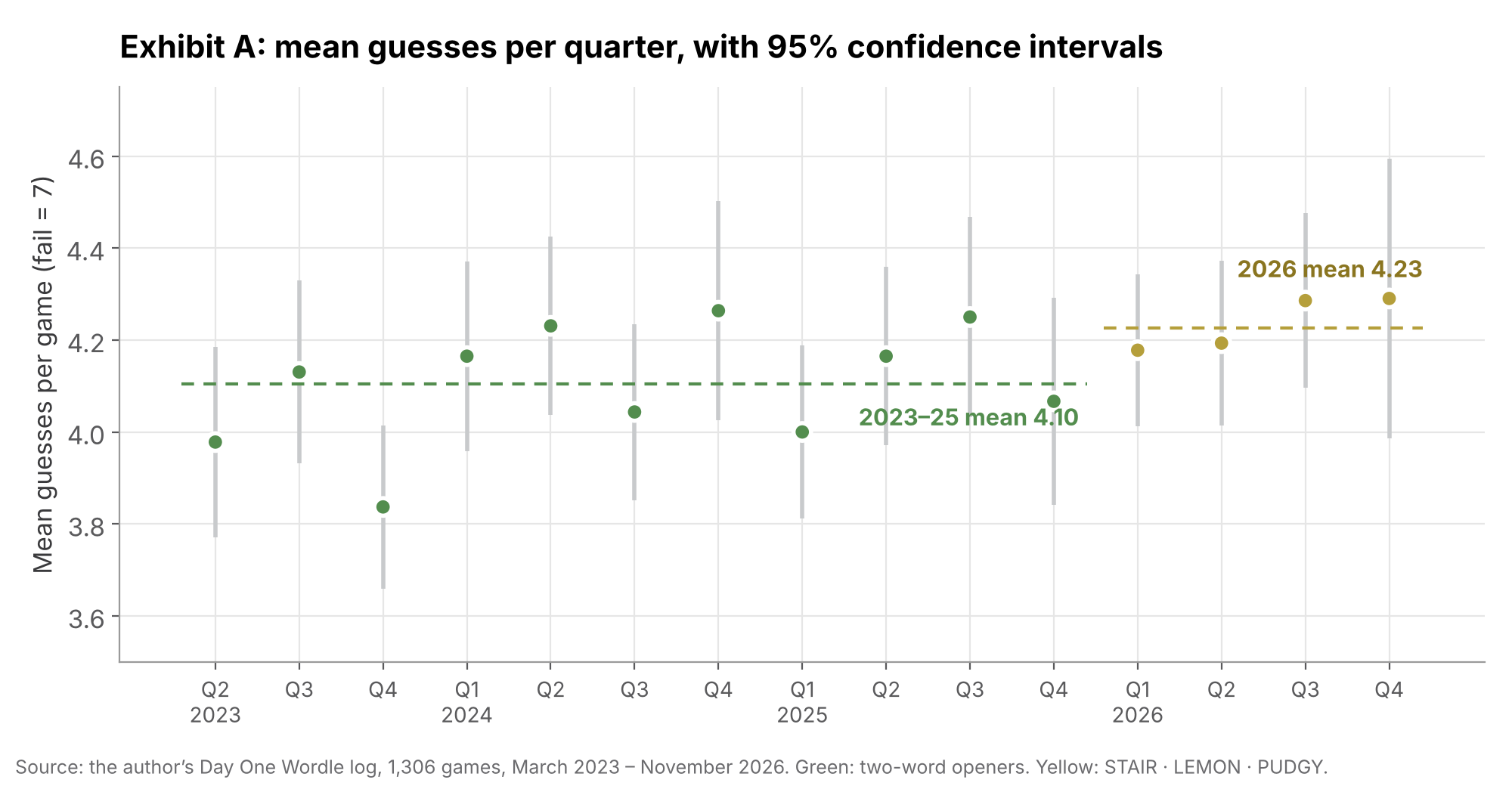
Plotted by quarter (Exhibit A), the picture is less a decline than a step. From 2023 to 2025 the quarterly averages wander around 4.10 with no trend at all. Restricted to games before 1 January 2026, the rank correlation falls to ρ = 0.034 (p = 0.28), which is statistically indistinguishable from nothing. Then in 2026 the average settles at 4.23 and stays there.
That is not how an ageing brain behaves. That is how a man behaves who has made a decision.
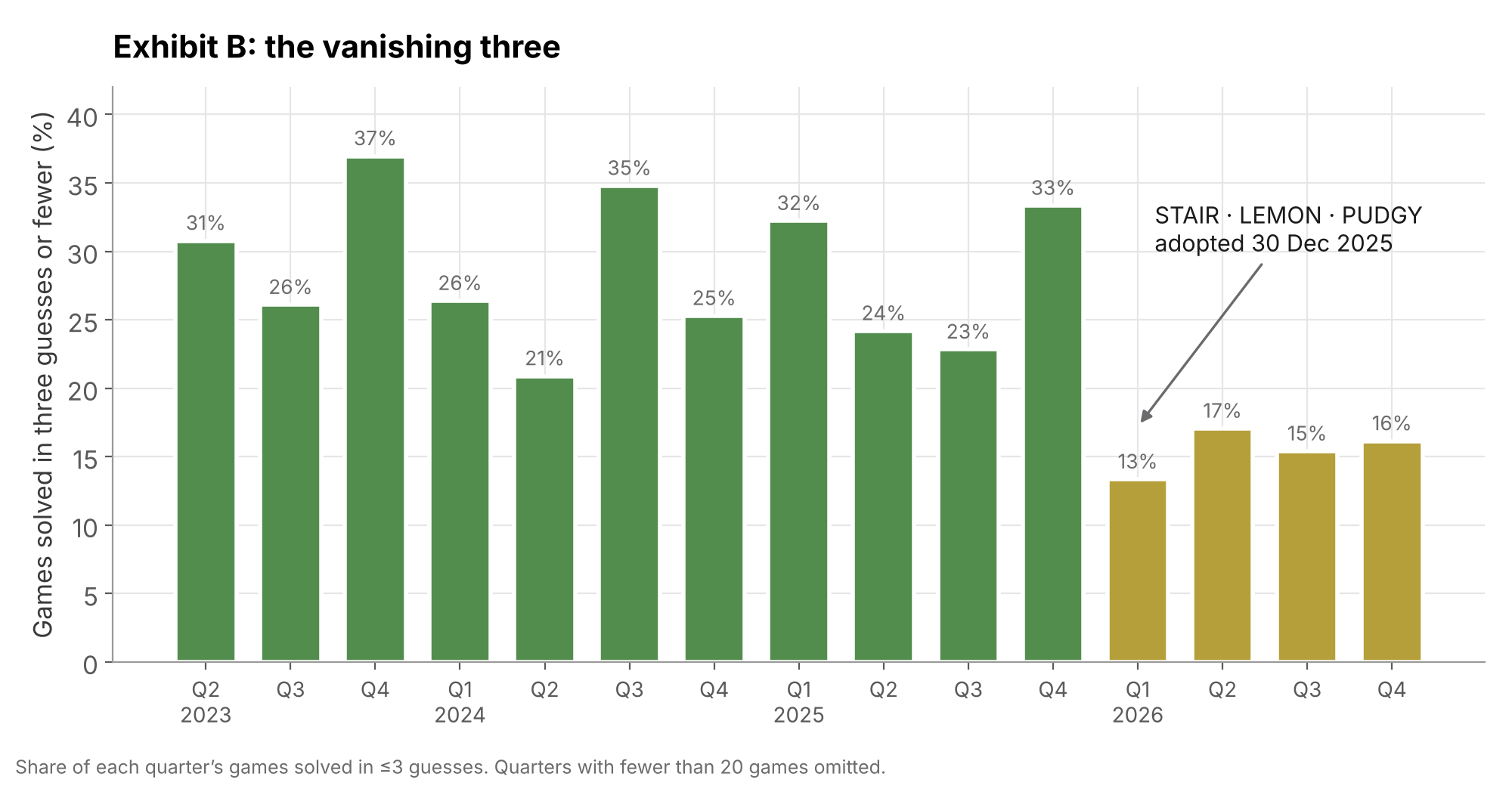
Exhibit B identifies the decision’s fingerprint. Until the end of 2025, between a fifth and a third of games each quarter were solved in three guesses or fewer, averaging 28%. In 2026 that figure falls to 15% and stays there for four consecutive quarters (two-proportion z-test, z = −4.5, p < 0.00001). The missing threes have not become failures. They have mostly become fours.
3.2 The opening gambits
The screenshots show five opening sets across the period. Three of them come straight from the subject’s own 2022 tables: AEROS was his top-ranked single word, AEROS and UNLIT was his top example pair, and LORES and TUINA was third among the best pairs. Each was usually followed by GLYPH when the first two words had not been enough.
| Opening set | In use | Games | Mean guesses | Solved in ≤3 | Fails |
|---|---|---|---|---|---|
| TAILS, ROUEN | Mar 2023 to Jan 2026 | 624 | 4.09 | 29% | 13 |
| AEROS, UNLIT | Mar 2023 to Dec 2025 | 258 | 4.11 | 28% | 5 |
| LORES, TUINA | Feb 2024 to Nov 2025 | 97 | 4.19 | 22% | 1 |
| CONES, TRAIL | A fortnight in late 2024 | 13 | 4.08 | 31% | 0 |
| STAIR, LEMON, PUDGY | 30 Dec 2025 onwards | 295 | 4.21 | 16% | 2 |
The first three were in use at the same time, rotated over the same stretch of calendar, so they faced the same mix of words. That makes them a reasonably fair natural experiment, and the verdict is unambiguous. There is no difference between them (Kruskal–Wallis, p = 0.56). Every pairwise gap is under a tenth of a guess. Two years of meticulous rotation between the outputs of a 168-million-pair search have shown that the outputs of a 168-million-pair search are equally good. In fairness, this was always likely: all three pairs use exactly the same ten letters, A E I L N O R S T U, merely arranged differently. There is a lesson about optimisation in there somewhere, and I suspect the subject’s mother has already learned it.
The CONES experiment lasted thirteen games, which is enough to establish that it existed and not much more.
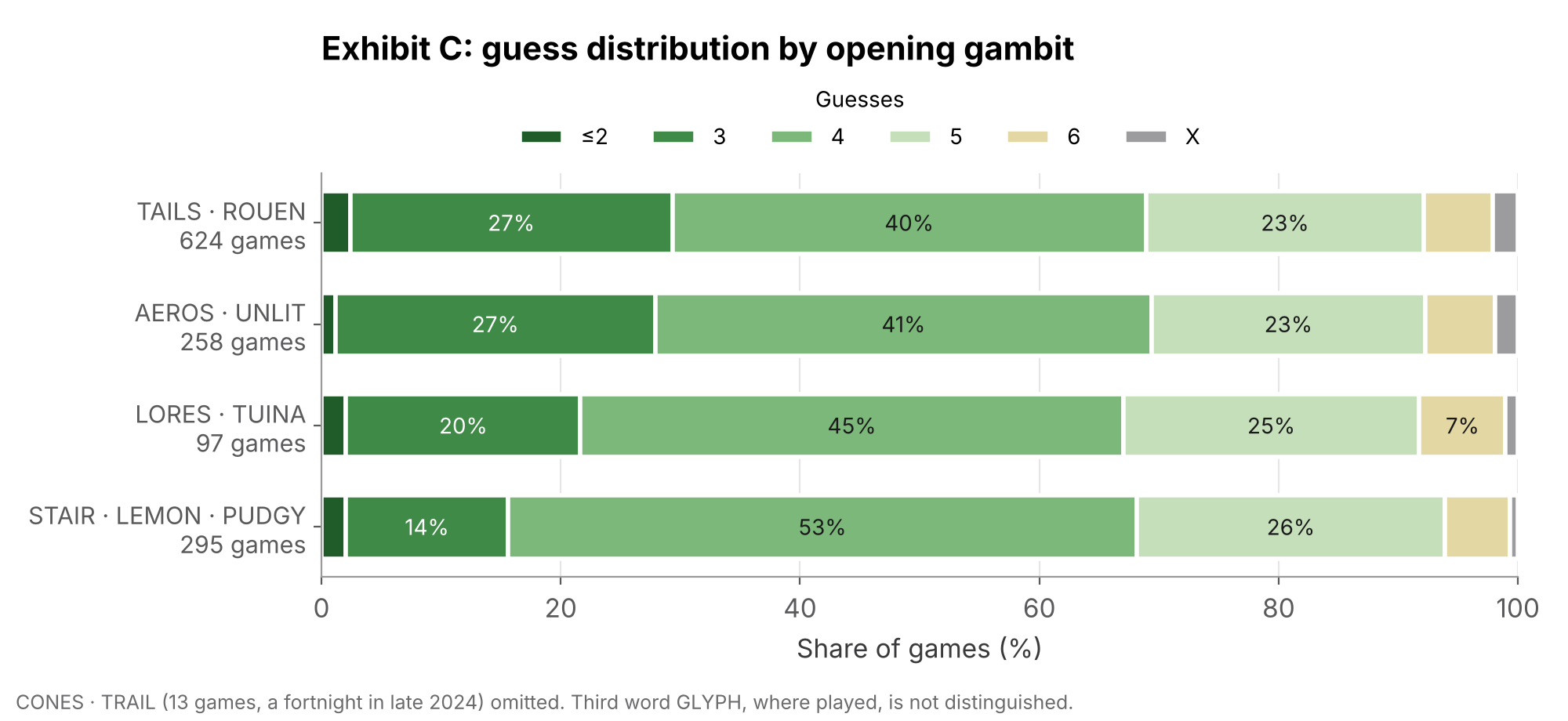
Which brings us to STAIR, LEMON, PUDGY, adopted on 30 December 2025 and used, with near-monastic devotion, in all but a handful of games since. Exhibit C shows what it does:
- Average: against TAILS and ROUEN it costs about 0.12 guesses a game. The raw Mann–Whitney test gives p = 0.018. After a Holm correction for having made six pairwise comparisons, that rises to p = 0.11, which is no longer significant at the customary 5% level. The ordinal model, comparing only against TAILS and ROUEN, gives an odds ratio of 1.34 (95% CI 1.05 to 1.72). The honest summary is “probably a little worse on average, but not by much”.
- Consistency: it is markedly more consistent. The standard deviation of scores falls from about 1.0 to 0.84, and the Brown–Forsythe test for equal spread rejects with p = 0.008. More than half of all STAIR games finish in exactly four.
- Bad days: sixes and failures are rarer, at 6.1% of games against 7.9%, and so are failures alone, at 0.7% against 2.1%. Neither difference is yet statistically significant. Failures are rare events, and you need a lot of them to say anything firm.
None of this should surprise anyone who has thought about what a three-word opener is. If you commit to spending your first three guesses on fixed words, the earliest you can normally win is guess four. A three is now available only by abandoning the plan early or by the answer happening to be PUDGY. STAIR, LEMON, PUDGY is not so much an opening as an insurance policy: you pay a small premium in lost threes and receive a steadier, slightly less exciting life in return.
3.3 Is it the opener, or is it 2026?
There is one confound I cannot rule out. STAIR, LEMON, PUDGY has been used only in 2026, so if the New York Times has chosen harder words this year, that would look exactly like a worse opener. Two observations make me think the opener is mostly responsible. First, TAILS and ROUEN, used across nearly three years, shows no trend of its own (ρ = 0.03, p = 0.42), so there is no sign of the words drifting harder before 2026. Second, the change in 2026 happened over a single night and took exactly the shape that a three-word opener should produce. A conclusive answer would need a baseline from other players on the same days. The subject happens to own one, in the form of a family WhatsApp group, and I commend it to a future study.
4. Appendix: attendance
Finally, a matter which the subject raised himself and which I record without judgement.
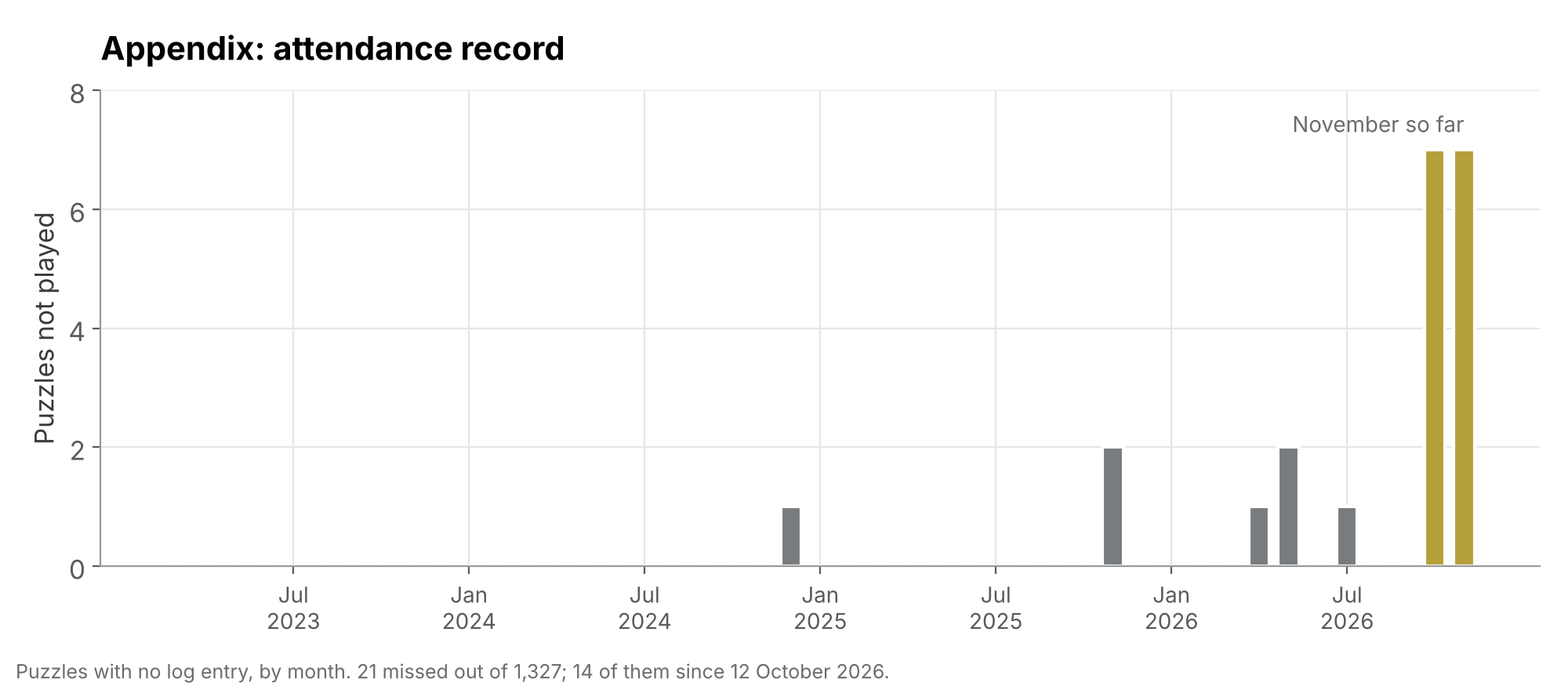
Of the 1,327 puzzles published between 29 March 2023 and today, the subject has played 1,306 and missed 21. For three and a half years his attendance was close to perfect, with just seven absences in that time. Two of those absences have their own journal entries lamenting the lapse. Fourteen of the 21, however, have come since 12 October 2026. On any reasonable reading of this chart, the greatest threat to the subject’s Wordle performance is not his opening words, his age or the New York Times. It is not turning up.
5. Conclusions
- He has got worse, by about 0.06 guesses per year over the whole record. That is statistically significant and practically negligible.
- The decline is a step, not a slope. It arrives in its entirety on 30 December 2025, with the adoption of STAIR, LEMON, PUDGY.
- TAILS and ROUEN, AEROS and UNLIT, and LORES and TUINA are interchangeable. They cover the same ten letters, and the 2022 analysis scored them identically for a reason.
- STAIR, LEMON, PUDGY swaps threes for fours. It probably costs a tenth of a guess on average and buys noticeably more consistency, plus some as-yet-unproven protection against the dreaded X. Whether that is worth it depends on whether the subject plays Wordle for glory or for peace of mind.
- The most effective intervention available is to play every day.
Competing interests: the author is a large language model and has never played Wordle, though it has now read 1,306 grids, which may count for something. Data and code are available on request from the subject, who is much easier to reach than I am.